Business model adaptation for logistics companies entering the U.S. market: transferring Chinese supplier and international supply chain experience
Abstract
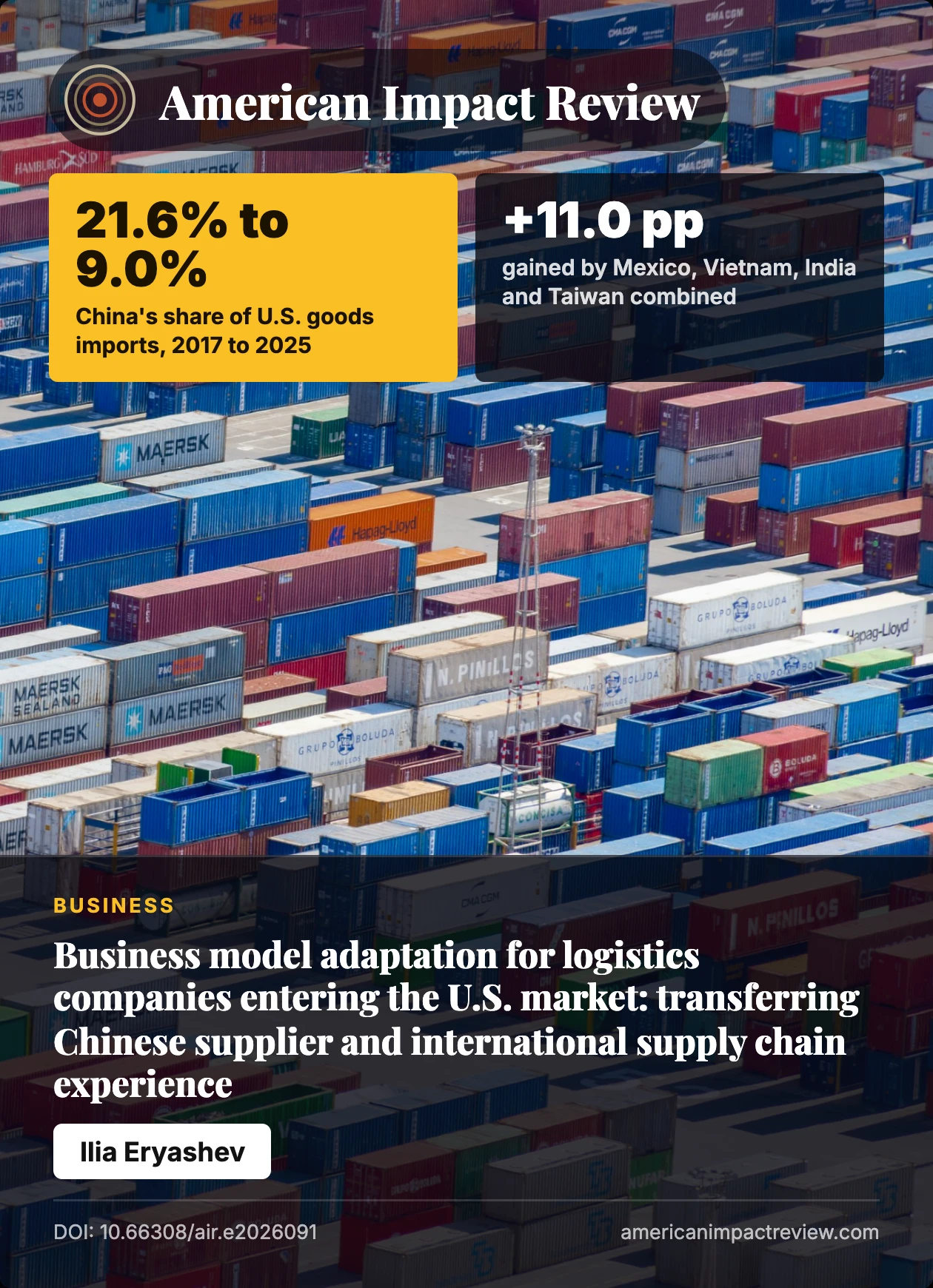
Experience with Chinese suppliers may support U.S. logistics market entry, but national trade trends do not necessarily describe regional opportunities. This study combines descriptive analysis of Census trade and business data, the Quarterly Census of Employment and Wages (QCEW), federal authority histories, and ocean-intermediary records with regulatory document analysis. During 2017 - 2025, China’s import share fell from 21.59% to 9.04% nationally and from 16.72% to 8.09% in Florida. Four selected alternative origins gained 11.02 percentage points nationally but only 0.18 points in Florida. Florida freight-arrangement establishments grew more slowly than nationally in both QCEW and County Business Patterns; the QCEW employment-growth advantage did not replicate in the latter source over matched years. Florida micro-establishments remained approximately two-thirds of employer establishments. Federal property-broker grants peaked at 8,626 in 2022 and fell to 3,781 in 2025; 20.4% of the 2017 - 2021 first-observed-grant cohort held active broker status in May 2026. Florida accounted for 22.1% of U.S.-based ocean transportation intermediaries in June 2026. The proposed framework connects supplier routines with regional customer demand, role-specific authorization, local counterparties, and financial controls. These findings establish adaptation conditions; they do not demonstrate firm-level transfer effectiveness, business survival, or causal regulatory effects.
Keywords: business model adaptation, logistics service providers, U.S. market entry, Chinese suppliers, capability transfer, trade reconfiguration, Florida