Behavioral preparation for awake oral hygiene and calculus reduction in dogs
Abstract
Background: Daily oral hygiene is recommended for dogs, yet its delivery depends on the animal accepting repeated mouth handling. Concerns about anesthesia also lead owners to seek awake cleaning, although this term covers interventions with different purposes and evidence bases.
Objective: To examine evidence for behaviorally supported oral hygiene without sedation, including whether repeated care can reduce existing calculus, and to distinguish these outcomes from those of professional periodontal treatment.
Methods: A structured narrative review integrated canine oral-hygiene trials, behavioral studies, and veterinary dental guidelines. Targeted searches of Europe PMC and verification against full texts and publisher records were updated on September 18, 2026. Evidence was classified by initial dental status, intervention, treatment frequency, outcome, and examination conditions. No pooled effect estimate was calculated.
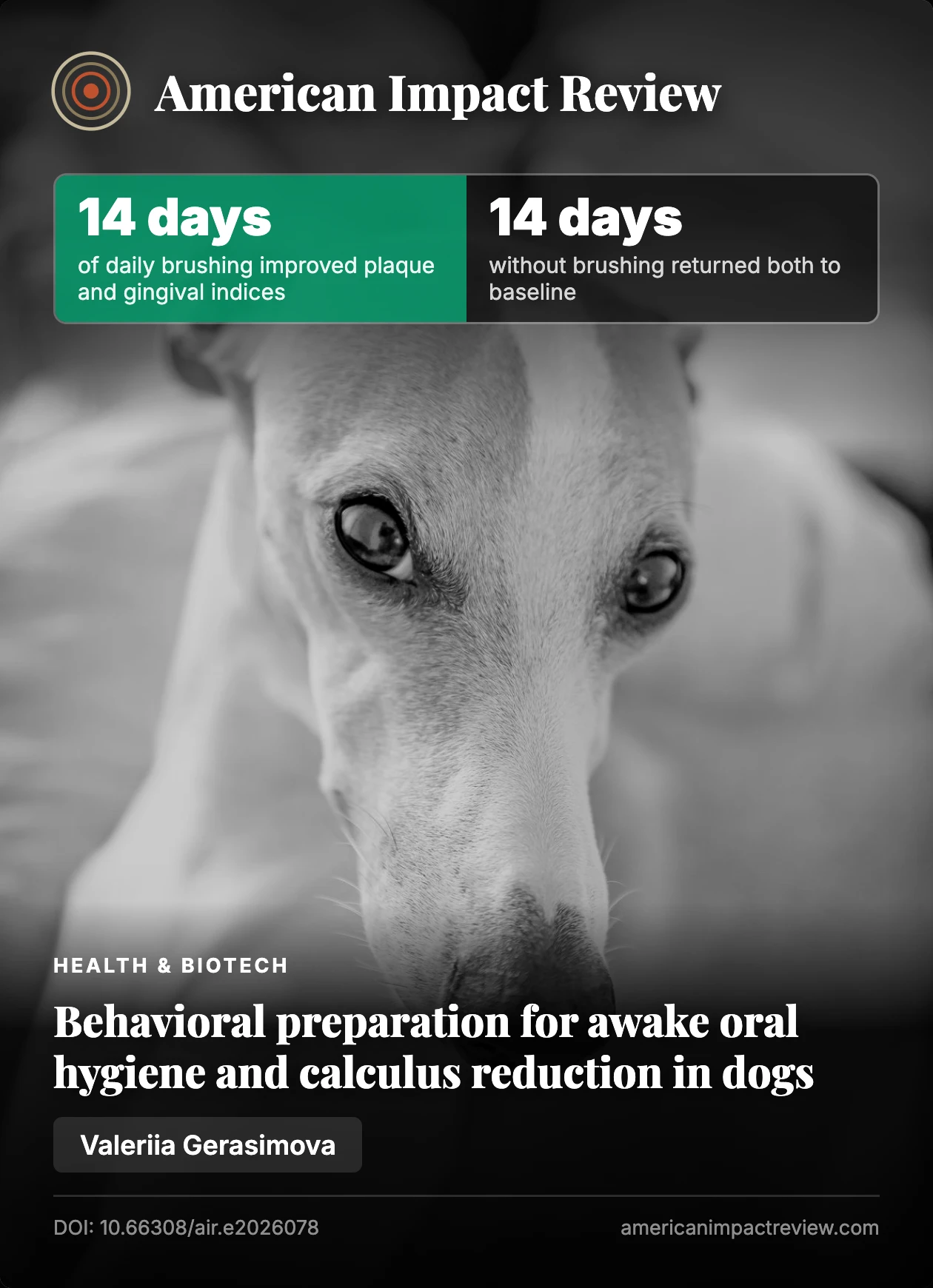
Results: Controlled and longitudinal studies support regular awake brushing for plaque control and improvement of visible gingival inflammation. A controlled greyhound study demonstrated reduced visible calculus scores without preliminary scaling, while a trial in unscaled client-owned dogs found partial reductions in combined dental deposits with selected homecare regimens. Daily manual or ultrasonic brushing and textile cleaning also improved plaque and gingival indices in beagles, with declining behavioral stress scores over time. However, calculus findings varied across studies. A recent pilot found no visible calculus reduction after a single ultrasonic-toothbrush session in live dogs. These results do not establish the effectiveness of awake ultrasonic scaling or equivalence to comprehensive dentistry under anesthesia.
Conclusions: Behavioral preparation can support sustainable awake oral hygiene. The defensible clinical objectives are regular plaque removal, improved tolerance, and, in some settings, partial reduction of visible calculus. Established periodontal disease requires veterinary assessment; successful handling does not replace diagnostic access, analgesia, or airway protection.
Keywords: dogs, cooperative care, desensitization, oral hygiene, tooth brushing, dental calculus, ultrasonic toothbrush, animal welfare
Cite asValeriia Gerasimova (2026). Behavioral preparation for awake oral hygiene and calculus reduction in dogs. American Impact Review. https://doi.org/10.66308/air.e2026078Copy
Declarations
Data availability
No new experimental dataset was generated. The evidence discussed is identified in the reference list. No individual animal records from the author's practice were used. Figures 2 and 4 replot published summary statistics from Rooney et al. [5] and Enlund et al. [9]; the transcribed values accompany the figure files. Figures 1, 3 and 5 are conceptual syntheses of the cited literature.
Ethics statement
This article reviews published literature. No new animal experiments, human-participant research, or patient-data collection were undertaken for this review.