Delivery-Time-Weighted Critical Stock Model (DTW-CSM): Min/Max Calculation Methodology for Geographically Distributed Machinery Fleets
Abstract
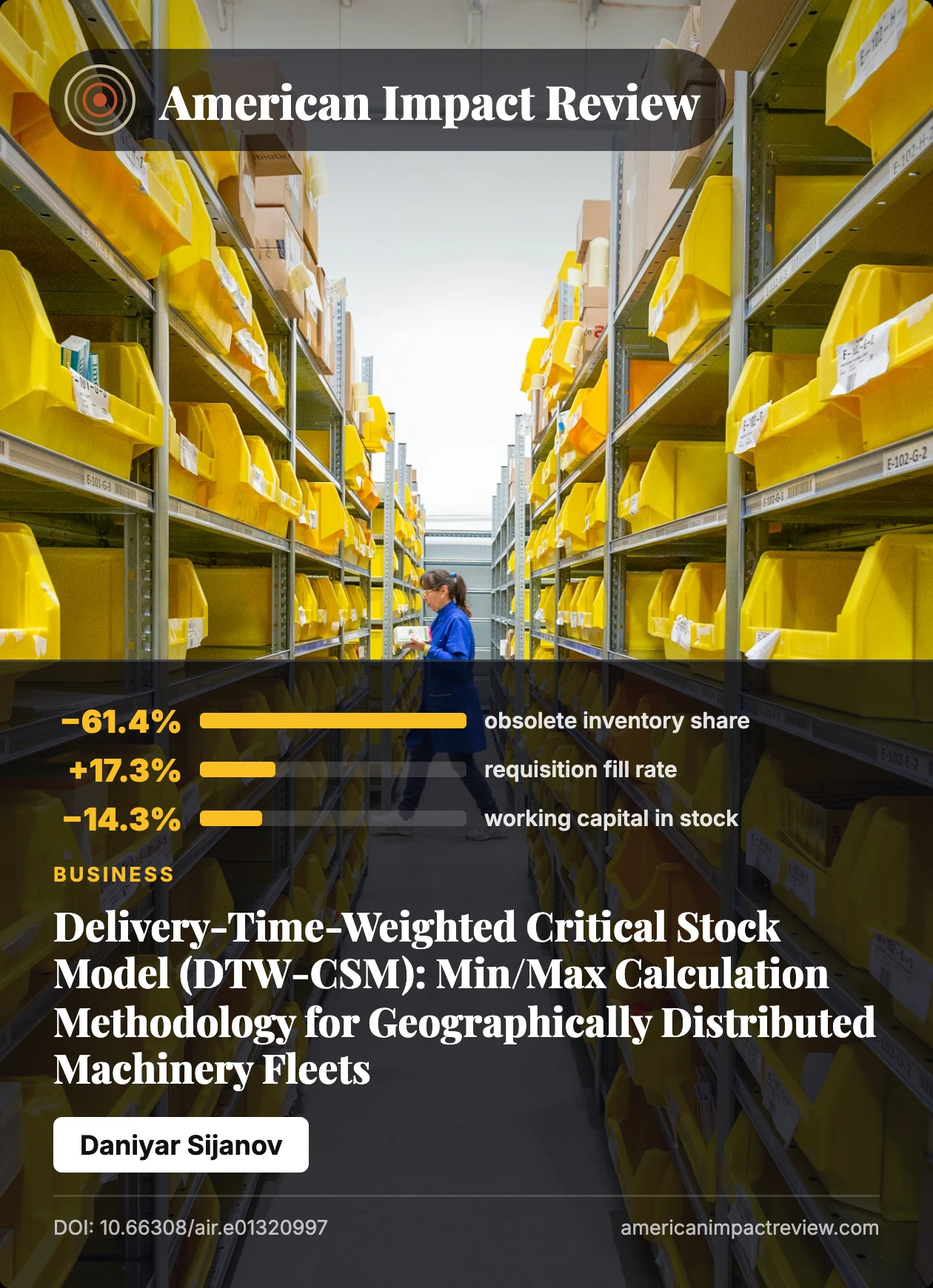
Continuous supply for geographically remote fleets of specialized machinery is a critical factor in mining, construction, and agriculture. Standard threshold inventory control schemes, such as classic min/max models, fail when logistics operations face volatile lead times or asymmetric downtime costs caused by failure of different components. To address this challenge, this paper introduces the Delivery-Time-Weighted Critical Stock Model (DTW-CSM). The model ties replenishment thresholds directly to lead time variance and a functional criticality coefficient. This methodology mitigates unscheduled equipment downtime while avoiding excessive working capital tie-up. Mathematical formulations, an industry classification matrix, a numerical demonstration, and empirical field results are presented.
Keywords: Threshold inventory control, Min/Max model, Logistic lead time, Supply lead time variability, Criticality rating, Safety stock, Fleet downtime